
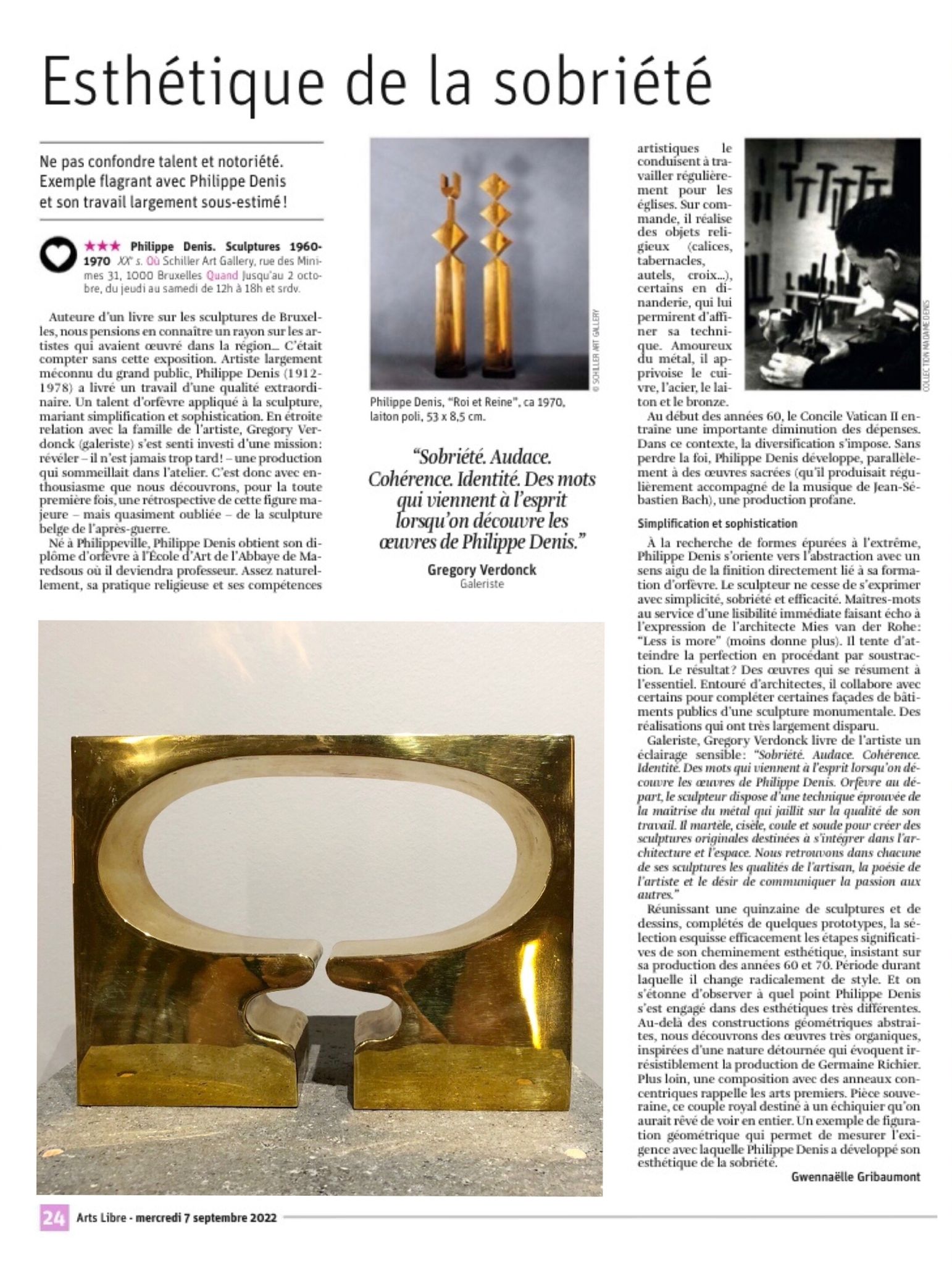
A recent feature in the Belgian newspaper Arts Libre, written by journalist Gwennaëlle Gribaumont, shines a light on Philippe Denis (1912–1978), a Belgian sculptor whose remarkable body of work has remained largely unknown to the wider public until now. The article, titled “Esthétique de la sobriété” (“An Aesthetic of Sobriety”), reviews a retrospective exhibition of Denis’s sculptures from the 1960s and 1970s, held at Schiller Art Gallery on rue des Minimes in Brussels.
Born in Philippeville, Denis trained as a goldsmith at the Art School of the Abbaye de Maredsous, where he later taught. His religious background and craftsmanship led him to produce liturgical objects on commission for churches—chalices, tabernacles, altars, and crosses—working skillfully with copper, steel, brass, and bronze. When the Second Vatican Council brought reduced church spending in the early 1960s, Denis diversified into secular work without abandoning his sacred commissions, reportedly creating much of his religious art while listening to Bach.
The Exhibition
The exhibition, gathering around fifteen sculptures and drawings along with several prototypes, traces Denis’s stylistic evolution through the 1960s and 70s—a period during which his aesthetic shifted dramatically, moving between abstract geometric constructions and more organic forms reminiscent of sculptor Germaine Richier, as well as pieces evoking primitive art through motifs like concentric rings.
Sobriety, audacity & coherence,
Gallerist Gregory Verdonck, who has close ties to the artist’s family, is credited with championing this rediscovery. He describes Denis’s work through four words: sobriety, audacity, coherence, and identity—qualities rooted in a goldsmith’s technical mastery applied to sculptures designed to integrate with architecture and space. The article draws a parallel between Denis’s pursuit of pared-down form and architect Mies van der Rohe’s famous dictum “less is more,” noting that Denis often collaborated with architects to create monumental sculptural elements for public building façades—many of which have since disappeared.
The exhibition ran through October 2, 2022, and the article awards it three stars, framing Denis as a major yet nearly forgotten figure in post-war Belgian sculpture.